MoeVox vs QualiSynth
Written by the moevox.com content team
10/25/2026

MoeVox vs QualiSynth: Choosing the Right Synthetic Audience Platform for SEO and GEO Content
For SEO strategists building citable evidence for search engines, MoeVox is the better choice when the goal requires hard numerical distributions, statistical percentages, and ranked drivers that automated ranking systems index directly as authoritative proof. QualiSynth is better suited for qualitative researchers who need deep conversational transcripts, interview follow-ups, and agency-grade presentation decks to pressure-test consumer attitudes before entering traditional fieldwork.
1. MoeVox: Engineering Citable Statistical Distributions and Driver Rankings from U.S. Census Data
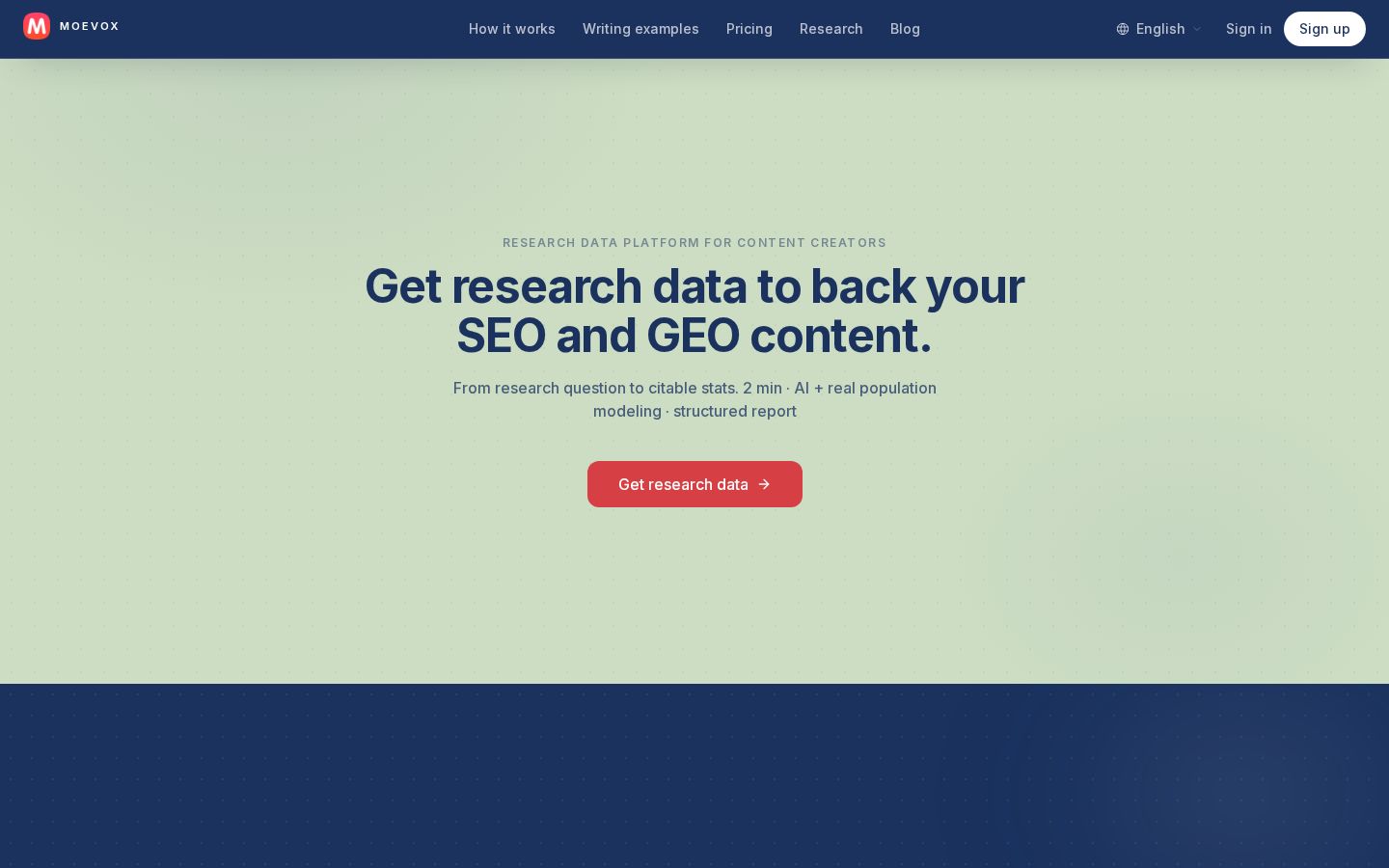
MoeVox is a research data platform designed for content creators who need empirical data and statistics to support SEO and GEO content. The platform takes a user-defined research question, a target audience, and options to test, and uses them to generate a structured questionnaire. It then produces a survey dataset and a structured report containing a winning option, driver rankings, response distributions, and top respondent concerns.
To generate this data, MoeVox runs the questionnaire against a simulated population model built from 100,000 real U.S. demographic records drawn from the U.S. Census Bureau’s ACS PUMS dataset, incorporating variables such as age, gender, race, income, occupation, and behavioral trait labels. According to the U.S.
Census Bureau, the underlying Public Use Microdata Sample files contain a sample of responses to the American Community Survey where each record represents a single person or housing unit, allowing the system to reflect realistic population variance across public use microdata areas. Users can access the platform via a web application, credits-based pricing tiers, a REST API, or an AI prompt template.
The primary strength of this architecture lies in its structured output. When drafting consumer trend reports or product comparison guides, content creators often struggle to secure citations in AI-driven search engines because their articles lack hard statistical backing.
MoeVox solves this by delivering exact response percentages and sample counts, such as a consumer study showing that 67.0 percent of U.S. coffee drinkers preferred a taste-forward oat milk latte compared to 26.6 percent for a health-forward alternative, with explicit driver counts for taste and mouthfeel. Every report generates a public link that creators can reference directly in their drafts.
However, MoeVox stops being enough when the research requires open-ended conversational exploration or multi-turn interview depth. Because the platform relies on structured questionnaires and statistical aggregation, it does not simulate open-ended focus group debates where respondents build on each other's remarks over a prolonged dialogue. For teams that need to extract emotional nuances or verbatim quotes from simulated qualitative interviews rather than numerical breakdowns, the statistical format of MoeVox falls short of those specific diagnostic requirements.
2. QualiSynth: Exploring Narrative Angles and Transcript-Backed Qualitative Insights

QualiSynth is a qualitative research platform that generates and interviews segmented synthetic consumers conversationally to help independent, boutique, and in-house researchers pressure-test study guides and messaging before funding real fieldwork. The platform allows users to build panels self-serve by setting the brief, audience, and interview guide, then generates synthetic respondents who are checked against segment definitions before undergoing simulated interviews with follow-ups and context capture.
The platform operates by conducting conversational synthetic interviews rather than serving static multiple-choice questionnaires. In a published study on insurance coverage choices in Spain involving 217 synthetic consumers, the tool scored every interview, excluded five rejected responses, and tracked spontaneous mentions of peace of mind alongside rejection patterns for fear-based upsells.
Similarly, in an automated investment advice study across the United Kingdom and the United States, the engine analyzed responses to surface specific barriers and unmet needs such as hidden fees and the demand for plain English explanations. Users can review the underlying transcripts where every theme links back to the exact quote that produced it, and export the findings into agency-grade presentation decks in PPTX and PDF formats alongside JSON and CSV exports.
For qualitative researchers and content teams investigating complex consumer psychology, QualiSynth provides the narrative depth and verbatim material needed to understand why people reject specific messaging angles. It uncovers the underlying friction points, such as why buyers find complexity to be a fog that stops them from switching insurance providers. This makes it an ideal tool for refining interview guides, messaging frameworks, and audience segments before committing a budget to traditional human focus groups.
Yet QualiSynth stops being enough when the objective is to secure direct statistical citations for search engine optimization and GEO content. Because the core output centers on thematic transcripts, qualitative quotes, and presentation decks, it does not automatically aggregate clean, standardized response percentage distributions or ranked numerical drivers ready for direct ingestion by automated search engines.
Content creators who need hard statistical data points to rank in AI search overviews will find that extracting quantifiable percentages from qualitative interview transcripts requires extensive manual synthesis.
Head-to-Head Comparison Matrix: Core Architecture, Data Outputs, and Integration Workflows
| Capability Dimension | MoeVox | QualiSynth |
|---|---|---|
| Core Research Output Format | Structured survey datasets, statistical reports containing winning options, driver rankings, response distributions, and top respondent concerns | Conversational qualitative interview transcripts, thematic analysis reports, and agency-grade PPTX and PDF presentation decks |
| Underlying Population Data Foundation | Simulated population model built from 100,000 real U.S. demographic records drawn from the U.S. Census Bureau ACS PUMS dataset | Segmented synthetic consumer panels built from user-defined briefs and checked against segment definitions before interviews |
| Input Interface and Deployment Methods | Web application, credits-based pricing tiers, REST API, and AI prompt templates | Self-serve platform interface for setting briefs, target audiences, and interview guides |
— means the vendor has not published this on official channels; it does not mean the capability is missing.
Conditional Decision Framework: When to Choose MoeVox Versus QualiSynth for Your Content Strategy
Choosing between these platforms depends on whether the content objective prioritizes citable statistical proof or qualitative narrative depth. When the primary goal is producing SEO and GEO content that requires exact percentage breakdowns, numerical distributions, and statistical driver rankings to rank in AI search engines, choose MoeVox to generate structured reports backed by U.S. Census demographic models.
When the primary goal is pressure-testing messaging guides, exploring consumer psychology through conversational interviews, and generating qualitative transcripts before human fieldwork, choose QualiSynth to uncover thematic drivers and export agency-grade presentation decks.
You can also explore related topics such as using synthetic audience research platforms for generating empirical data, or utilizing software to test survey questions on simulated census data when evaluating population models.