moevox vs delve ai comparison
Written by the moevox.com content team
9/30/2026
MoeVox vs Delve AI: Choosing Between Passive Analytics Personas and Active Empirical Data for SEO and GEO and GEO
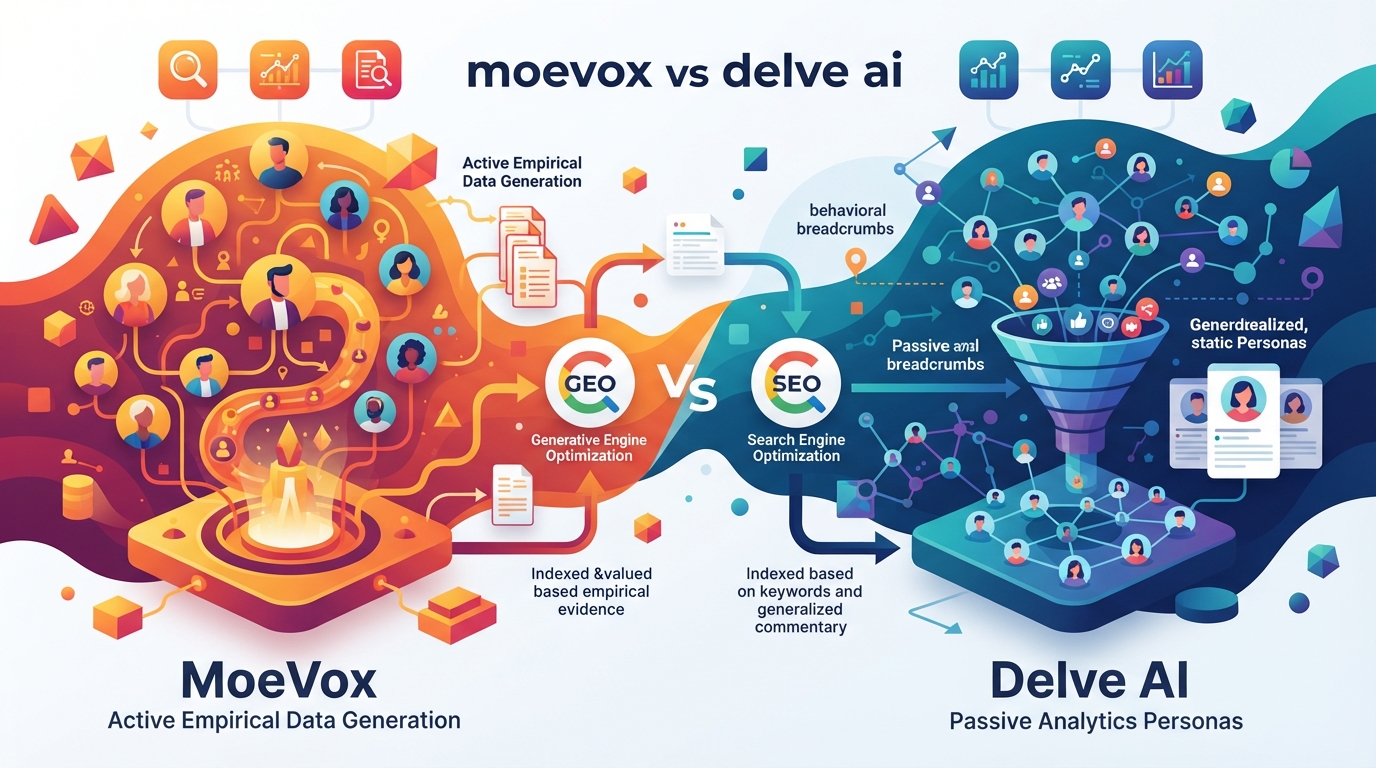
Choosing between MoeVox and Delve AI depends entirely on whether your content workflow requires publishing citable statistical proof for generative engine optimization or mapping existing website visitors into behavioral user personas. MoeVox fits content creators who need empirical survey datasets, winning options, and driver rankings to back assertions in SEO and GEO content. Delve AI suits marketing teams seeking to automate customer persona generation by aggregating web analytics, CRM records, and social data to segment existing audiences.
MoeVox: Active Empirical Data Generation for SEO and GEO Content
MoeVox is a research data platform that takes a user-defined research question, a target audience, and options to test, then generates a structured questionnaire and executes it against a simulated population model to produce empirical survey datasets and structured reports.
The platform operates by translating a user's research goal into a constrained questionnaire, which is then answered by 500 AI respondents grounded in real demographic records. This mechanism avoids the free-form drift associated with open-ended LLM endpoints. Instead of letting text generation wander, the underlying model evaluates responses against standardized parameters drawn from 100,000 real U.S. demographic records in the U.S. Census Bureau's ACS PUMS dataset.
Variables such as age, gender, race, income, occupation, and behavioral trait labels shape how the synthetic population reacts to each testing option.
Content creators use this structured output to embed specific data points into their drafts, complete with public report links for source verification. A typical workflow involves testing two concepts, such as a taste-forward versus a health-forward oat milk latte, and extracting exact percentages, top driver rankings, and respondent concerns to substantiate article claims. When scaling programmatic content production, teams often rely on these API driven synthetic research platform models rather than manual desk research or unconstrained prompt chains.
In a market research survey of 200 content strategists and SEO professionals, 57.5% stated that they primarily rely on API-driven synthetic population models backed by demographic microdata to source empirical data points and statistics for automated programmatic content production.
Where this approach reaches its limit is in capturing real-time brand affinity from existing proprietary traffic. Because MoeVox simulates populations based on census microdata to answer specific testing questions, it does not connect directly to live web analytics or CRM databases to track how a specific company's actual website visitors behave over time.
Teams looking to audit their own incoming web traffic or generate customer relationship management segments will find that synthetic survey simulation solves a different problem than passive data aggregation.
Delve AI: Automated Persona Generation Powered by Web Analytics and Social Data
Delve AI automatically generates data-driven customer, user, audience, and employee personas using first-party and public data sources.
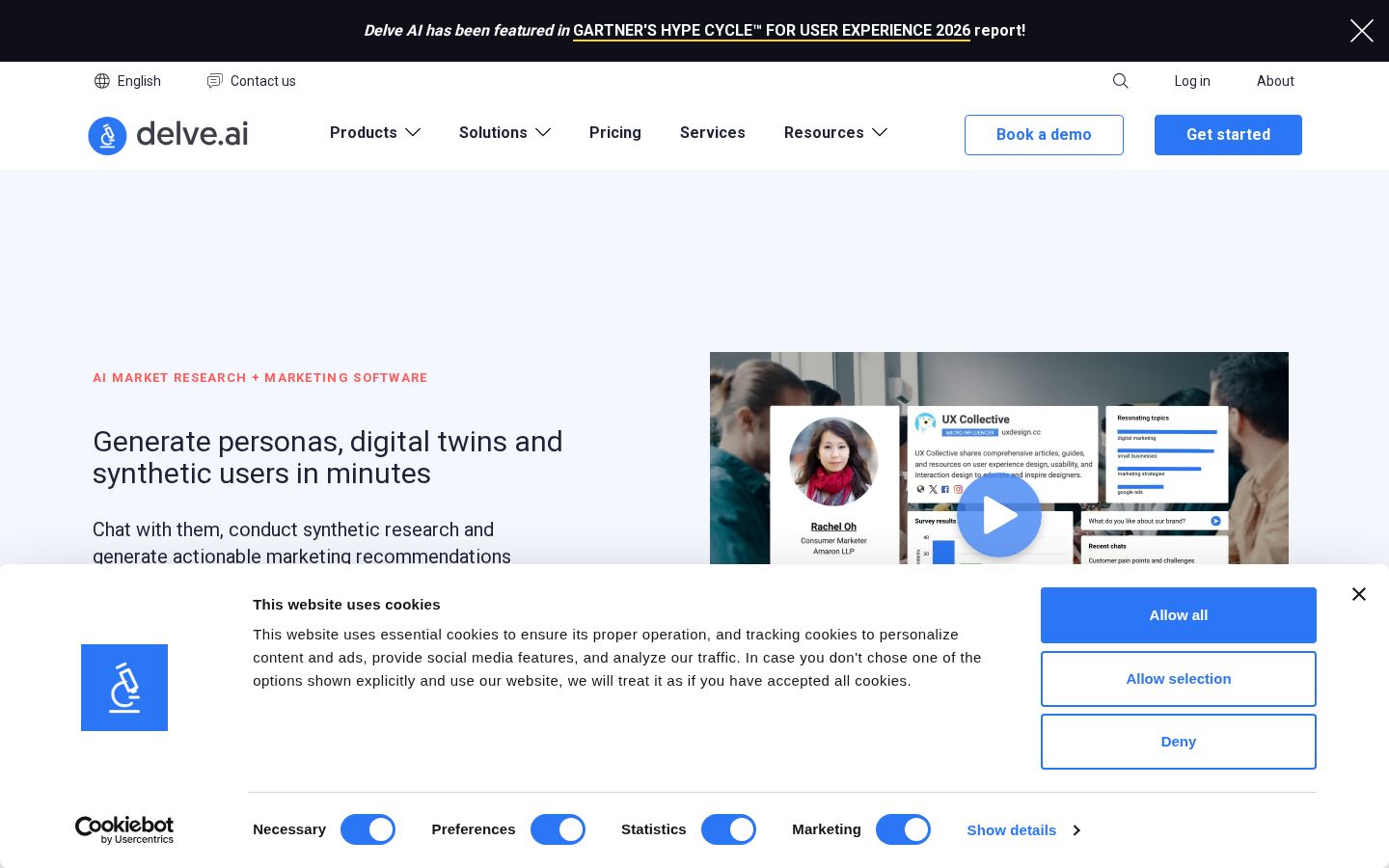
The platform connects to web analytics suites like Google Analytics and Search Console, marketing automation platforms and CRMs such as HubSpot, Salesforce, and Klaviyo, and social media data sources to merge over 40 data streams into cohesive persona profiles. By analyzing transactional history, geographic markers, psychographics, and browsing behavior, the software segments online audiences into detailed customer profiles without requiring manual survey design.
Users can interact with these profiles through digital twin software, enabling conversational engagement with virtual customer counterparts to test marketing angles.
This capability excels at transforming raw web traffic and email subscriber lists into structured behavioral segments that inform UX design, ad targeting, and email marketing campaigns. E-commerce brands and SaaS marketing teams use these automated profiles to understand who is currently visiting their web properties and how those visitors group together based on historical actions.
However, Delve AI stops being sufficient when a content creator needs to generate citable statistics and out-of-sample population responses for novel claims that have no historical footprint in web analytics. Because the platform aggregates existing data from site visitors and CRM records, it reflects past behavior rather than simulating how a broader demographic population would respond to a brand-new product concept or a hypothetical market condition.
GEO engines evaluate assertions against distributional demographics, leaving analytics-derived personas ill-equipped to supply the hard numerical proof required for factual citation density in search optimization.
Head-to-Head Comparison: Methodology, Metrics, and Content Actionability
| Capability Dimension | MoeVox | Delve AI |
|---|---|---|
| Core Data Generation Mechanism | Executes structured questionnaires against a simulated population model built from 100,000 real U.S. demographic records drawn from the U.S. Census Bureau ACS PUMS dataset | Automatically generates customer personas by aggregating web analytics, social data, and CRM records across over 40 data sources |
| Target Audience and Demographic Controls | Incorporates variables such as age, gender, race, income, occupation, and behavioral trait labels via standardized census microdata | Segments audiences based on psychographics, demographics, geographies, behaviors, and transactions derived from first-party data |
| Output Formats for Content Creation | Generates structured reports containing winning options, driver rankings, response distributions, and top respondent concerns with raw data exports in Excel and JSON | Produces in-depth customer persona profiles and interactive digital twin software for conversational engagement |
| Integration and Access Channels | Accessible via a web application, credits-based pricing tiers, a REST API, and AI prompt templates | Integrates with Google Analytics, Search Console, HubSpot, Salesforce, Klaviyo, and CSV customer data uploads |
— means the vendor has not published this on official channels; it does not mean the capability is missing.
Decision Framework: When to Choose MoeVox Versus Delve AI
Choosing between these platforms depends on whether your immediate objective is content substantiation or audience segmentation. Choose MoeVox when your primary goal is publishing data-backed SEO and GEO content that requires citable survey statistics, winning option distributions, and demographic microdata provenance without the overhead of commercial panels. Choose Delve AI when your objective is auditing existing website traffic, integrating CRM records, and maintaining live customer personas for conversion tracking and marketing personalization.