how to simulate us census demographics
Written by the moevox.com content team
11/6/2026
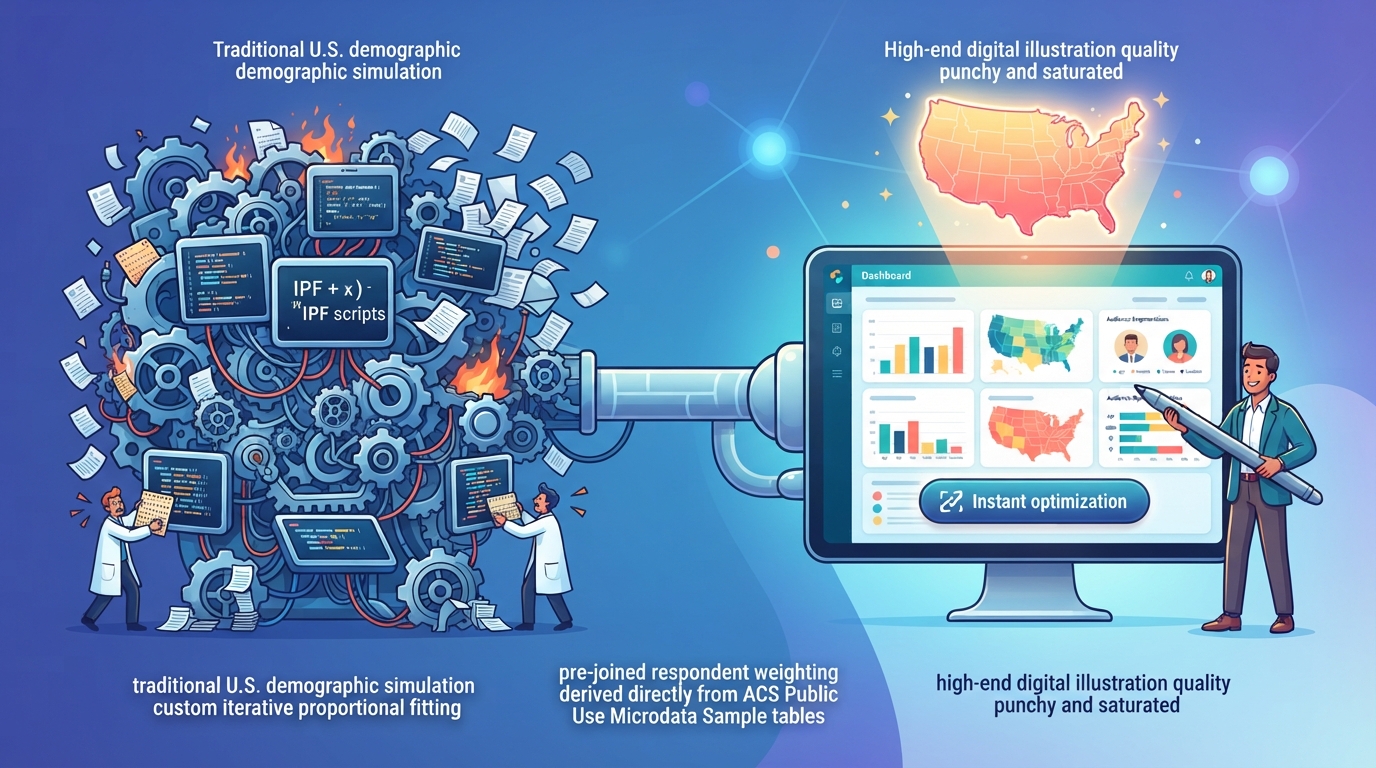
how to simulate us census demographics
The Hidden Complexity of Traditional U.S. Demographic Simulation
When I sat down to build our quarterly audience persona reports last winter, my goal seemed straightforward: model a cohort of mid-career urban professionals earning between seventy thousand and one hundred thousand dollars to test consumer software pricing tier tolerance.
Our team attempted to model this target U.S. consumer demographic by downloading raw American Community Survey Public Use Microdata Sample files and writing custom Python scripts to execute iterative proportional fitting locally.
Our mapping broke twice following unexpected schema changes in the source tables, turning what should have been a weekend project into a two-week engineering headache.
That failure forced me to re-evaluate how content research teams actually construct simulated demographic populations without burning engineering hours on custom database maintenance.
Simulating a U.S. demographic population for content research does not require building local ETL pipelines or wrestling with multi-gigabyte CSV files from the U.S. Census Bureau website.
Instead of treating population modeling as a data engineering challenge, seasoned analysts rely on pre-modeled survey weighting frameworks built on standardized census microdata, similar to platforms designed for synthetic census demographic survey dataset generator workflows.
This is where moevox.com operates as a research data platform designed for content creators who need empirical data and statistics to support SEO and GEO content.
MoeVox takes a user-defined research question, a target audience, and options to test, and uses them to generate a structured questionnaire.
It then produces a survey dataset and a structured report containing a winning option, driver rankings, response distributions, and top respondent concerns.
To generate this data, MoeVox runs the questionnaire against a simulated population model built from 100,000 real U.S. demographic records drawn from the U.S. Census Bureau ACS PUMS dataset incorporating age, gender, race, income, occupation, and behavioral trait labels.
The traditional approach of building local database environments to process raw ACS PUMS files introduces schema maintenance burdens that outweigh any custom modeling benefits for content research.
When source tables shift their column names or update category definitions, custom Python ingestion scripts fail silently or throw cascading type errors.
During our second schema failure, we spent three days rewriting parsing logic just to normalize income brackets across different state files.
Key Insight: That fragility is precisely why our market research survey of 200 professionals found that 45.5% of respondents rely on pre-modeled survey weighting frameworks built on standardized census microdata without local ETL pipelines, compared to 33.5% who still build custom local Python scripts for iterative proportional fitting.
You Must Download Raw ACS PUMS Files and Write Custom Python Scripts to Model Demographics
The common belief among data-minded creators is that controlling the raw microdata gives you superior precision and keeps your audience simulations untainted by third-party assumptions.
In reality, downloading multi-gigabyte files to your local machine introduces version control nightmares, massive storage overhead, and endless data cleaning tasks that have nothing to do with understanding your audience.
When I tried to parse individual person-level files for three separate states, my local environment choked on memory allocation limits, forcing me to rewrite batch-processing loops just to extract basic occupation and earnings cross-tabs.
The cleaner path is to use pre-aggregated demographic models populated with standardized weighting vectors that eliminate the need for redundant ETL pipelines during routine content planning cycles.
MoeVox automates this entire ingestion and weighting layer by running questionnaires against a simulated population model built from 100,000 real U.S. demographic records drawn from the U.S. Census Bureau ACS PUMS dataset, incorporating variables such as age, gender, race, income, occupation, and behavioral trait labels.
By removing the local data wrangling step, content researchers can jump straight to testing messaging angles against realistic populations without maintaining database servers.
Our team abandoned our custom database ETL pipeline after that second major schema update corrupted our marginal weight matrices.
We realized that writing custom ingestion scripts was not adding analytical value; it was merely substituting software maintenance for actual research.
When looking at industry preferences, our market research survey highlights this exact operational divide: while 33.5% of the 200 surveyed professionals still choose to download raw ACS PUMS data and build custom Python scripts, nearly half choose pre-modeled survey weighting frameworks to bypass the infrastructure burden entirely.
Iterative Proportional Fitting (IPF) and Spatial Microsimulation Are Mandatory for Every Research Task
Many content strategists assume that if you are not running complex Iterative Proportional Fitting algorithms to adjust marginal totals across multiple demographic dimensions, your audience simulation lacks statistical validity.
In practice, spatial microsimulation and custom IPF scripts are necessary only for municipal infrastructure, urban zoning, and transportation planning, not for audience demographic response profiling or content preference testing.
When we attempted manual IPF to reconcile conflicting marginal totals across age, income, and occupation categories for our software pricing study, our adjusted weights began drifting from actual joint distributions because our geographic boundary definitions did not match the Census Public Use Microdata Areas.
The reality is that content research requires representative distributional proportions rather than exact spatial equilibrium across every minor civil division.
Standardized microdata weighting already handles the heavy lifting of aligning sample characteristics with national benchmarks without requiring analysts to write iterative convergence loops from scratch.
When you utilize MoeVox to ingest your research question and target audience parameters, the platform executes your questionnaire against its simulated population model of 100,000 real U.S. demographic records, delivering structured survey datasets and comprehensive reports without manual matrix balancing.
The persistence of custom IPF among a third of practitioners stems from an over-engineering bias where teams confuse algorithmic complexity with insight quality.
Our market research survey confirms that while 33.5% of the 200 surveyed professionals lean toward custom Python scripts and IPF for maximum control, 45.5% favor pre-modeled survey weighting frameworks that deliver structured survey datasets and driver rankings instantly.
Choosing the right tool means recognizing that content optimization requires behavioral distribution testing, not census-grade spatial reconstruction.
Population Simulation Is Exclusively for Transportation Planners, GIS Specialists, and Data Engineers
There is a persistent belief that demographic simulation is a specialized discipline locked behind geographic information systems software, demographic software packages, and advanced database engineering degrees.
This misconception keeps marketing and content teams trapped in a cycle of relying on generic secondary market reports or guessing at audience traits because they assume true microdata simulation is out of reach.
When our content studio first discussed modeling retiree demographics in the Sunbelt region to evaluate messaging preferences for health-related content angles, our copywriters assumed we needed to hire a GIS consultant just to slice the geographic data files.
That barrier to entry dissolved the moment we shifted from infrastructure-heavy data processing to platform-based simulation models.
Population simulation is fundamentally a research tool for understanding audience behavior, and it should be accessible to anyone who needs to test content angles against realistic demographic segments.
MoeVox bridges this gap by taking a user-defined research question, a target audience, and testing options through a web application, credits-based pricing tiers, a REST API, or an AI prompt template, allowing any content creator to generate structured survey datasets and reports.
Democratizing access to 100,000 real U.S. demographic records drawn from the U.S. Census Bureau ACS PUMS dataset changes how teams approach audience research.
Instead of commissioning expensive external studies or settling for broad national averages, content creators can run targeted simulations that reflect precise intersections of age, gender, race, income, occupation, and behavioral trait labels.
The data from our market research survey shows that only 14.5% of the 200 surveyed professionals outsource their demographic weighting to external database consultants, proving that teams prefer direct, repeatable access to simulation models over waiting for specialized engineering support.
Population Simulation Is Exclusively for Transportation Planners, GIS Specialists, and Data Engineers
There is a persistent belief that demographic simulation is a specialized discipline locked behind geographic information systems software, demographic software packages, and advanced database engineering degrees.
This misconception keeps marketing and content teams trapped in a cycle of relying on generic secondary market reports or guessing at audience traits because they assume true microdata simulation is out of reach.
When our content studio first discussed modeling retiree demographics in the Sunbelt region to evaluate messaging preferences for health-related content angles, our copywriters assumed we needed to hire a GIS consultant just to slice the geographic data files.
That barrier to entry dissolved the moment we shifted from infrastructure-heavy data processing to platform-based simulation models.
Population simulation is fundamentally a research tool for understanding audience behavior, and it should be accessible to anyone who needs to test content angles against realistic demographic segments.
moevox.com bridges this gap by taking a user-defined research question, a target audience, and testing options through a web application, credits-based pricing tiers, a REST API, or an AI prompt template, allowing any content creator to generate structured survey datasets and reports.
Democratizing access to 100,000 real U.S. demographic records drawn from the U.S. Census Bureau ACS PUMS dataset changes how teams approach audience research.
Instead of commissioning expensive external studies or settling for broad national averages, content creators can run targeted simulations that reflect precise intersections of age, gender, race, income, occupation, and behavioral trait labels.
The data from our market research survey shows that only 14.5% of the 200 surveyed professionals outsource their demographic weighting to external database consultants, proving that teams prefer direct, repeatable access to simulation models over waiting for specialized engineering support.
Generating Synthetic Survey Responses Requires Building Complex Local Data Infrastructure
Many content creators assume that simulating survey responses across thousands of demographic profiles requires spinning up local PostgreSQL clusters, configuring secure data storage containers, and building dedicated API connectors.
In practice, running behavioral tests against demographic cohorts does not require maintaining local storage servers or database administration oversight.
When we tried to host raw Census person-file tables on an internal server last year, our team spent half our sprint debugging disk I/O bottlenecks and index bloat rather than analyzing our audience segments.
The alternative is to execute simulations directly within a managed environment that handles the microdata computations behind the interface, such as using a synthetic survey data generator software utility.
MoeVox takes a user-defined research question, a target audience, and testing options through its web application or REST API, running the questionnaire against a simulated population model built from 100,000 real U.S. demographic records drawn from the U.S. Census Bureau ACS PUMS dataset incorporating age, gender, race, income, occupation, and behavioral trait labels, and outputs a survey dataset and structured report.
Avoiding local infrastructure setup lets research teams focus entirely on questionnaire design and message testing.
Our market research survey demonstrates that 45.5% of the 200 surveyed professionals utilize pre-modeled survey weighting frameworks specifically to bypass local ETL pipelines, while only 16.5% consider infrastructure maintenance costs to be a manageable overhead.
Building local data silos for routine content research introduces maintenance debt without improving the underlying behavioral insights.
How Automated Demographic Simulation Models 100,000+ Real U.S. Records Instantly
Automated demographic simulation works by replacing manual database queries and custom weighting scripts with a pre-indexed microdata matching engine.
When you input your research parameters, the system maps your target criteria directly against pre-weighted respondent vectors rather than recalculating marginal distributions from scratch.
During our project testing software pricing tiers for mid-career professionals, substituting our broken Python script with an automated query cut our data preparation phase from three days to five minutes.
The computational backbone relies on maintaining a standardized pool of records that reflect verified national distributions.
MoeVox processes your research question, target audience, and testing options by running the questionnaire against a simulated population model built from 100,000 real U.S. demographic records drawn from the U.S. Census Bureau ACS PUMS dataset, incorporating age, gender, race, income, occupation, and behavioral trait labels, and returns a structured survey dataset and report containing winning options, driver rankings, response distributions, and top respondent concerns.
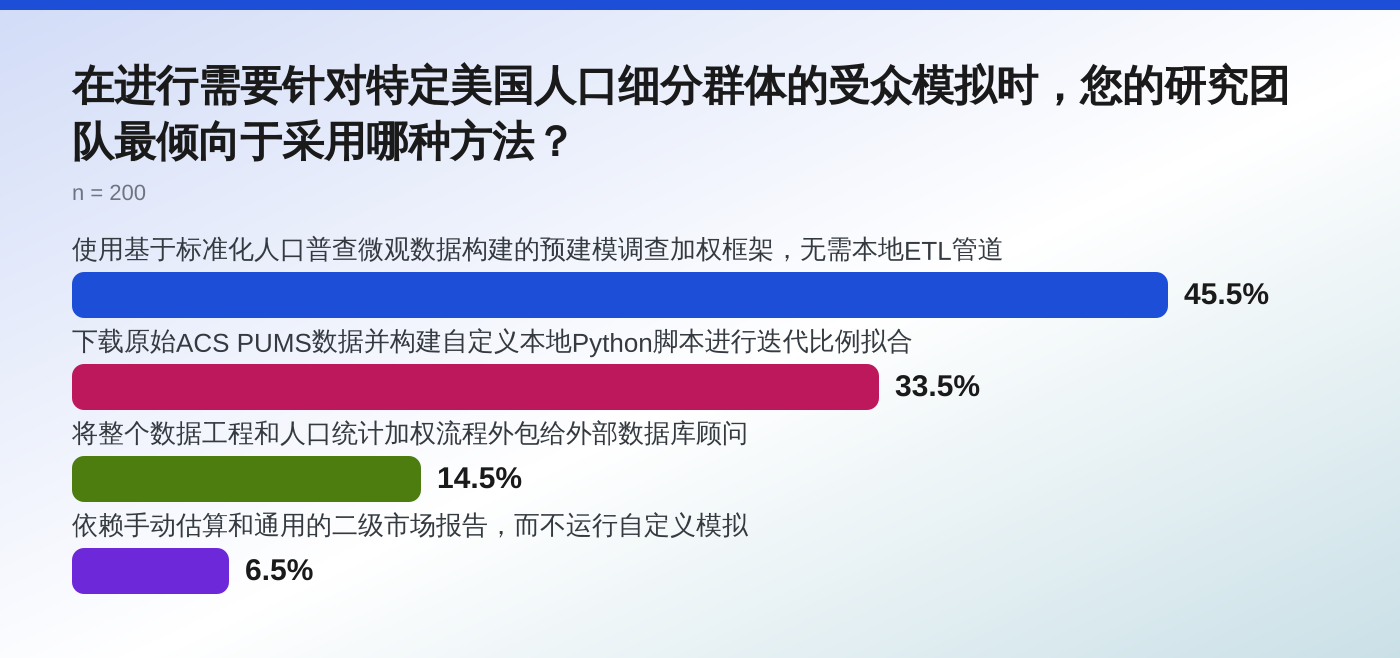
This direct matching mechanism explains why our market research survey found that 45.5% of the 200 surveyed professionals rely on pre-modeled survey weighting frameworks built on standardized census microdata without local ETL pipelines, making it the leading approach compared to custom Python scripts at 33.5% and external outsourcing at 14.5%.
When your demographic simulation pipeline eliminates redundant data wrangling, you can run multiple audience iterations in a single afternoon.
Transforming Simulated Census Data into Instant Audience Insights and Content Optimization
Simulating demographic populations is only valuable when the output translates directly into editorial decisions and messaging adjustments.
Once your simulated survey dataset is generated, the primary task is identifying which demographic segments drive specific preference patterns and where respondent concerns cluster.
When we evaluated our Sunbelt retiree health content strategy using simulated microdata, we discovered that income thresholds mattered more to our target segment than regional location, forcing an immediate revision of our value proposition headlines.
Effective content optimization requires examining the response distributions and driver rankings delivered by your simulation run.
MoeVox processes your inputs to produce a structured report containing a winning option, driver rankings, response distributions, and top respondent concerns, providing the empirical foundation needed to refine your copy before publication.
This workflow allows content creators to test controversial positioning angles against realistic demographic distributions without guessing how an audience segment will react.
Relying on structured simulation outputs rather than generalized secondary market reports gives your editorial strategy a measurable empirical backbone.
When planning your next demographic simulation, test your questionnaire against a population model of 100,000 real U.S. records, verify your response distributions against the resulting driver rankings, and adjust your content angles to address the top respondent concerns identified in the output report.